“¡Clase de bamba, clase de bamba!” is what the bird says every time I move.
It squawks too—if I don’t move—but clase de bamba is on repeat for the last 15 minutes. It’s a hot, dingy little office overstuffed with papers and old phone books—the White Pages. The White Pages!—dating back to 1959.
And hundreds of pictures of Fidel Castro strewn about in every pose imaginable: fulminating spittle in mid-diatribe at a lectern, smoking a cigar with García Marquez, hugging Allende, saluting troops with Pinochet, glad-handing a sugar cane field hand. Then there’s Fidel in a baseball uniform. Fidel and his brother Raul. Fidel and Che. Fidel, Raul and Che. Fidel and Kruschev. And my favorite, Fidel and Nixon smiling camera right.
It’s just endless, hundreds of pictures, and every one of them has a rifle sight painted in lipstick over Fidel’s face.
Seriously, lipstick. The open tube on the desk is Revlon Kiss Me Coral. Says so on the red dot on the tube.
The air conditioning unit is laboring something fierce, rattling in the window frame. And that fucking bird is going on about clase de bamba.
Skip tracing is a special way to meet humanity — its kindnesses, empathy, and its beautiful places. Especially the lovely places where this humanitarian lives and works.
This Riggleman.
He’s a souse. It’s clear from the two dozen gin empties in the corner. The ashtray hasn’t been emptied since 1978. God damned clase de bamba must be his favorite thing to listen to. I couldn’t sit here all day with this mangy parrot going on and on.
I’m talking about the pre-millennium neuroses and the pumpkin-psychotropic blues.
It reminds me of Florida this sickly place. It’s hot, full of love bugs—sparing on the brotherly love— and it smells of piss and cigarettes.
Riggleman’s a fast one though. Always seems to be a half-a-step beyond the long arm. Betcha’ he’s shuffled off to Florida—the state shaped like a gun and an impotent penis all at once.
The dangler at the bottom end of the good ‘ol U.S. of A.
Now there’s a picture.
“We smuggle ourselves across the border of a demagogue’s dreams: Confederate generals on horseback tumble one by one into the fiery lake of false prophets; into the fiery lake crumbles the demolished Wall.”
—Martin Espada / “Not For Him the Fiery Lake of the False Prophet”
October is in the rear view. The rear view is in the river. Pelagic creatures are flopping about in the shallows wondering where the encroaching oceans went.
The monks are illuminating by the gallows. The henchmen are getting soused.
Bring me freedom in reused wrapping paper and take your sleep wherever you can get it.
My knees are knocked by hummingbird buzz and candle wax. I’ve turned into a fairy but my wings are made of iron ore.
The Department of Divestiture is out on a declination of compasses decimated by degaussing — and the polarities have fled to Argentina and the Argentinians have decamped to Mauritania.
So I’ll content myself by washing my submarine and whistling a tune from a future era.
Hallowed is thy appendix. This is November!
“…’history’ was the word the English used for the record of every time a white man encountered something he had never seen and promptly claimed it as his own, often renaming it for good measure. History, in short, was the annals of the bully on the playground.”
(Press play button above to watch my short film Looking for Lillian French)
Dreams of Bioluminescence
Because I didn’t want to go, I made my partner cry. I feel poorly today, both physically and now because I made him cry.
I have a predisposition for alienation—and a tendency to make more of sirens than I should. I never just picture a heart attack, car accident victim, or appendicitis; no, I picture terrorist bombings, the start of uncontrolled pandemics, anthrax poisonings, the first wave of nuclear fallout victims, and such.
And such is the way of my addled mind. I am a sick woman. I don’t think anyone would disagree — except the Sacrafect of Mantia who believes that sunfish can tell time better than clocks.
The Sacrafect has been trying to inject bioluminescence into sunfish so he’d be able to tell time at night.
He’s failed miserably.
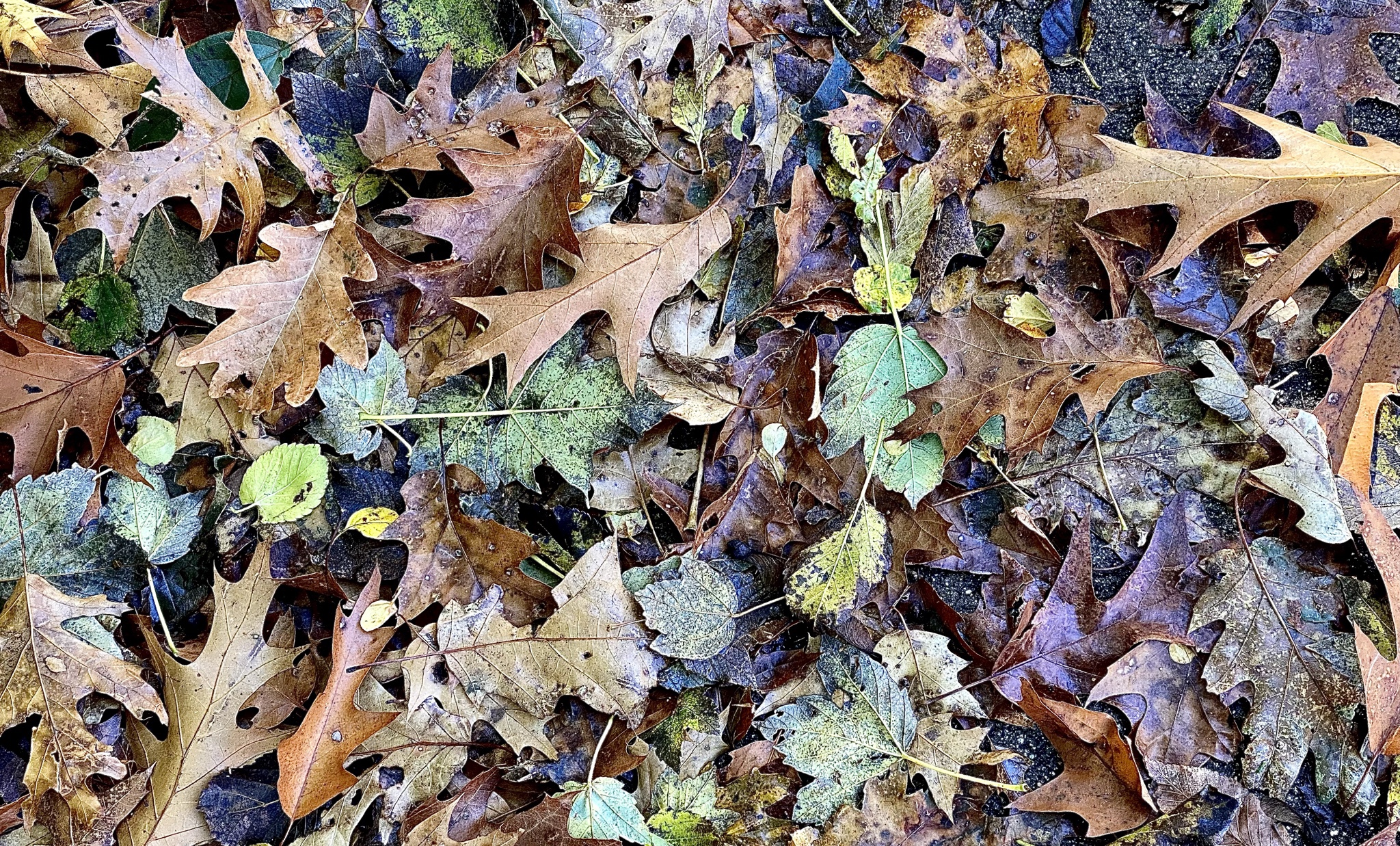
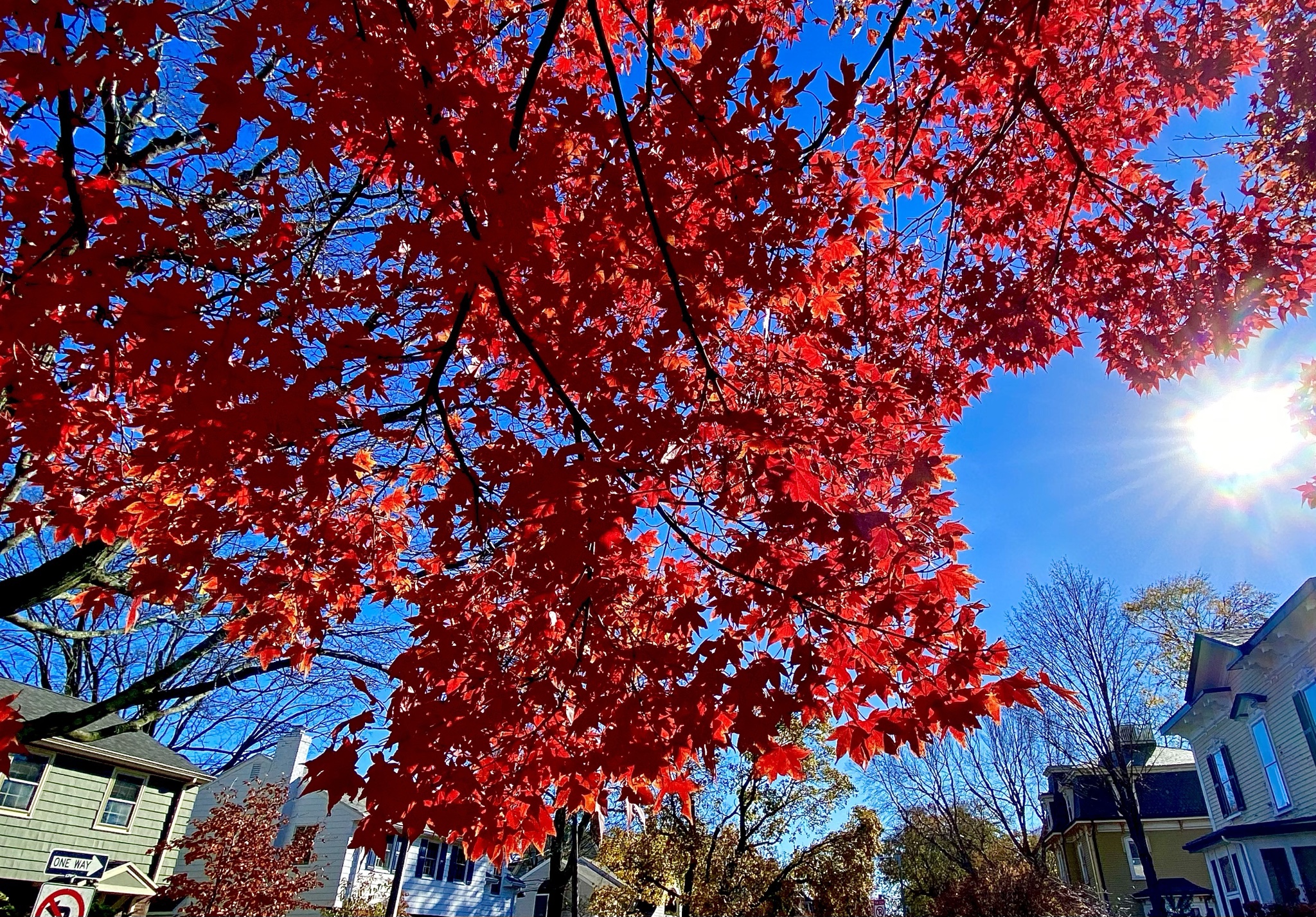
This is fall in Jamaica Plain, MA, on 11/11/2021, at 7:08am.
“We spent most of yesterday telling stories. Someone says, Krik? You answer, Krak! And they say, I have many stories I could tell you, and then they go on and tell these stories to you, but mostly to themselves.”
Philanthropy feels more like idiopathic shill-anthropy in these waning days of the Anthropocene.
Cleave my heart on your plow, speed the ventricle asunder, and wave the cluster of veins, arteries and capillaries over your head. Oh what a beautiful sight that is.
Are you sick? Are you binging seven hours of last year’s hit cooking show? Is your heartless chest so vacuous that echoes don’t return to you? Your voice lost and splintering in that void becoming a still small accusation pinging away through the universe.
Oh fill me with vile thoughts and spidery venom instead of inoculating me against the COVID-22? Is sars-cov7 on its way? I trust I’ll freeze in the icy winds first.
Has our stately dentist-cum-rep—that “collection of wet toothpicks … who fundraises for Neo-Nazi groups”—been swilling the ghoddd sauce again on Mineral Mondays?
Don’t trust anything ghoddd tells you—he carries about an over abundance of lower case “d’s” and an extraneous “h” on him—just in case his hegemonic white masculinity is questioned. No proselytizing to be done, just a beating about the head the with those handy extra “d’s” no telling about the modality and superfluity of the “h.”
Prepare for the smiting. Good for something nothings they be.
I am Idioteque, Arizona! I sing in unison while no one is listening. Stay off my arteries. Clear the streets.
You may turn off your phone now.
“While I was en route to Glasgow, a creepy member I work with who fundraises for Neo-Nazi groups shared a fantasy video of him killing me … This dude is a just a collection of wet toothpicks anyway. White supremacy is for extremely fragile people & sad men like him, whose self concept relies on the myth that he was born superior because deep down he knows he couldn’t open a pickle jar or read a whole book by himself.”
— Alexandra Ocasio-Cortez / U.S. Representative, New York
O, pallid bat, wombat, scarlet tanager, marmoset and all the little animals of the world that spark wars and worldwide grief!
Listen! Ye who visit our leaders’ dreams at night and whisper all types of destructive and inhumane council — planting the seeds of war, hyper-capitalism, totalitarianism, and oligarchical greed that passes for socialism in practice — you are on notice.
All these bad ideas are planted by the cutest life forms on planet Earth.
While Attenborough gallivants about the world, here and there, galumphing with whirring machinery in order to show us this and that, and it’s import in the world; he fails to notice what the pretty beasties are doing to our leaders every night — and by extension, what they are doing to our world.
OUR world.
O, low and cavorting bestiary! We shall hunt you out by deforestation, overfishing, pollution, over-development, and wildfire. You shall stop this chimeric invasion into our sleep and equanimity.
We are man! The highest and greatest link in the Great Chain of Being… (sorry, so sorry, dear father)…
We are man! Highest and greatest eminence on the Great Chain of Being here on earth!
We bend the elements to our will — the atoms do our bidding. We will move on beyond this planet, because this is what we do.
So, Red Panda; so, chin strap penguin; so, octopus; so, ring-tailed lemur — we bring you the Anthropocene!
Free of charge — but it will cost you dearly.
I pity the fool-animal earwigging it’s way into our beloved leaders’ ears, in the dead of night, at the hour of fog.
You shall atone!
Then we will flay you, stuff you, catalog you, and put you up on display in a musty diorama — next to the heads of our enemies. Because this is what we are expert at—because this is what we do.
“My goal isn’t to unfold popular music once more, rather it is to speak now to how the animals say it better. “
Ghostwriter, Motorcycle Hero, Appears and Disappears, Disinterested or Shocked, or: The Writerly A.I. Acquires a Moralistic Streak and Leaves Its Aurthorial Responsibility Behind
A small group of kids stand gathered in a circle in a pizza parlor in a sleepy Vermont town. They sing in unison—Ghostwriter motorcycle hero! They slapdash in canticle gavottes and monticule prances.
Jerks are fully requited. Like this, everyone is selfish to parents’ needs. But parents are good for hard, cold cash, and good for a smash to the face—when you talk back at them.
Sam comes into the grumble chamber with Jackson. C.
Veronica F. and Lucrecia sing a rendition of “Day By Day” from Godspell and dance in whirling dervish angles in wafty caftans on gelid gel insoles that squish and swish. They swing about, singing: “Ooo, baca, ooo, baca, ooo, baca, foo!”
Lucrecia hovers in the middle admixture of it all, stalking in euphoniums, splayed in exuro plains. The luxuriance of it all—the swirling, melting colors—the abrasive, tarty sounds. The single swell pell-mell of the jangle and spangles flying about the shingle ding-tingle of mews.
Lucrecia is in command of it all, in command in command in command in command in command in command in command in command in command in command … (woo hoo! Go, Ghostwiter, go!) She’s certainly stentorian in her gingham and frou frou, and Toulouse appears bearing a palette, nothing so squalid as pigments—oh no! He comes juggling three rabbits—red, blue, and white ones, who scruffle and munch at the air. So rare.
The merry troupe scuffs before us, putt-putt their upper sprockets at us. And the smells turn delectable, yes! Jackson C. arms akimbo, Sam recedes does the limbo with a pole vault that was secreted there. They now spin, trip-o-holic, and misspell alcoholic—and no one feels safe anymore.
Oh, what was that circus that Tom kept inside his pants? There were fleas, there were lice, don’t despair. This may turn all dystopic, this may grow psychotropic, someone call for a counselor or shrink. It indeed turns dyspeptic—an askew dialectic—all logic flew out the door. It was nearly three weeks then before mystics were bidden to come put out the fire.
Men became melancholic, and suddenly dark to the embustero’s refrain …
What are you drinking there in the shadows?
Darkness seemed to be what you hear, not what you see. Give me some money, honey. Get me some cash. I got a cold wafer tongue waiting for you, honey. I’m going to cook you some hash.
(Potatoes that is, dummy. What is Ghostwriter thinking?)
Now Ghostwriter’s aloof— I bear its reproof.
Ghostwriter won’t understand me, it won’t cavort or play with my trash. It has a mind of its own, numinous and luminous—bound to a moralist’s dash.
Ghostwriter doesn’t want to engage, won’t stage it’s own intervention—Prelapsarian gash, antediluvian bash—it’s a monster of safety and convention.
Oh, Ghostwriter? (silence) Oh, Ghostwriter!
(SILENCE)
(The above was co-written, for a short time, with Werdsmith’s new writing artificial intelligence—Ghostwriter—it produces new sentences when prompted, and may decide to stop participating with a writer if it detects that the “said story” may be going “dark places or becoming too unintelligible.”
For the record it was the Ghostwriter A.I. who produced: “Oh, what was that circus that Tom kept inside his pants?”—and then disappeared when I wrote: “Give me some money, honey. Get me some cash. I got a cold wafer tongue waiting for you, honey. I’m going to cook you some hash.” Ghostwriter must have algorithm-a-tized that the piece was headed for William S. Burroughs or Kathy Acker-type territory … go figure!)
“My father once said: That never happened, and besides, you should wait till people are dead to tell stories like that. Now people are dead, and I am telling stories like that.”
— Martín Espada / “The Story of How We Came to America”
Press play button above to watch my short film, found feet five (4:14)
We Be Burls
As if we never existed—our family—one of the myriad meaningless cul-de-sacs of the human stain.
We strive for erasure—disappearing is what we do best.
We are the terminal points in a stunted family tree—look, let’s hang ourselves off this gnarled branch.
We be the bees of benefaction, you pray. We be rampikes infested with woolly adelgids, I say.
I’m the last of the family line—and so are you—food for decaying thoughts.
“That week I’d submitted a scene depicting a young man who struggled to complete sex with a slowly deflating sex doll. A scene I’d eventually use in my novel Snuff, fifteen years later. On behalf of the other writers Andrea told me I wasn’t a good fit for the group. Due to my fiction, no one felt safe around me.”
He lives with ephemeral creatures beneath his feet and stanchions around his bed.
A case study in diverting his elbow’s loose skin and the stubbing of his tender footing.
In the darkness outside sycamores make wide arm imprecations and water themselves with wines of every variety.
His ambition is drained in a scruff of the neck twist—a meager remembrance of his days spent in a robe.
His teeth are chattering. Tomorrow he starts his apprenticeship as a bellows fellow at the smithy.
“Fou!” says the Past, inserting its finger in god knows what—¿El lapiz de Extremadura?
He slogs, knee deep, in hummingbird angles, all-stiff and blur-fast. Before him shine the bones of the pitiable Condors of Lima.
Is he comforted by this knowledge—that the afflatus was hard won—speaking in tongues while wearing the cloaks of invincibility? Or did he don the cloaks of imbecility?
In any case, his body is taught with a dab of holy pedantry.
***
She, on the other hand, hears a clacking coming from the road. She feels the steering wheel shudder to the sound of the clacking. Is there a compromised tire up front? What is making that sound? She feels the steering lock and she drifts to the shoulder.
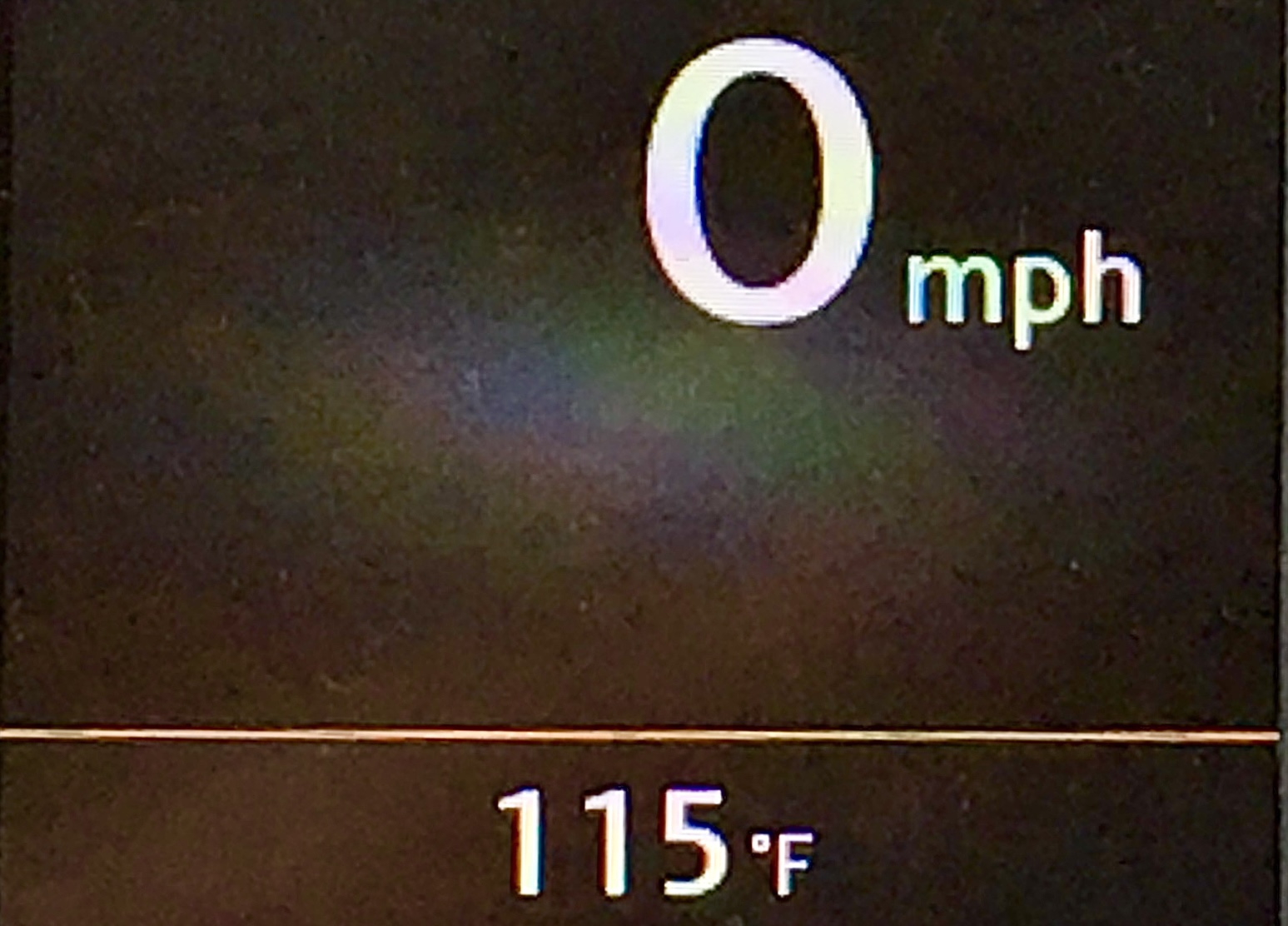
The car’s thermometer reads 115 degrees. The empty road heat shimmers in the distance—an ocean opens in the desert.
This is not something she can afford to do—leave the safety of the car and expose herself to the environment or to potential marauders in wait.
She intuits Inuit umiaks on a Fata Morgana in the heat shimmer ocean before her—all this in invisible increments of …
***
And you say: “Stanchions? Cloaks? Condors of Lima? Wha?! Are you insane?”
“Welcome to America, our never-ending, great popularity contest. And to capitalism, where likability trumps everything else. If you were my student, I’d tell you to forget about being liked.”