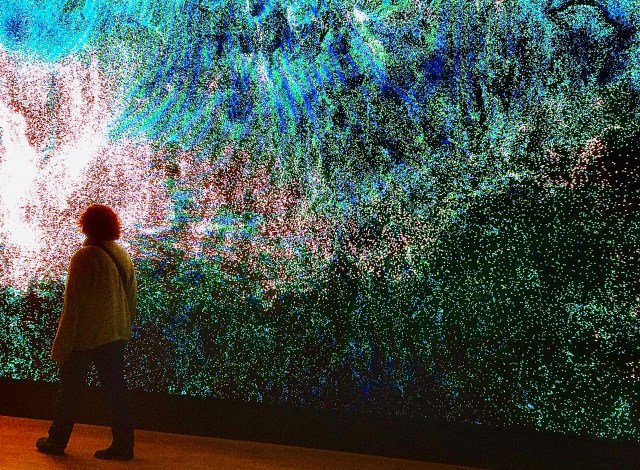
Waveless Delta
I read that men who have trouble falling asleep have a twenty five percent chance of dying earlier.
I vow to never sleep again…

“Good things, when short, are twice as good.”
— Baltasar Grazian

I read that men who have trouble falling asleep have a twenty five percent chance of dying earlier.
I vow to never sleep again…

“Good things, when short, are twice as good.”
— Baltasar Grazian

At 80 miles an hour, about two and a half hours east of Denver, she tore through the state line into Kanorado, Kansas and pumped the brakes upon sighting a half dozen state troopers lined up behind a jackknifed truck.
Thousands of Coca Cola bottles strewn about the Kansas countryside. Welcome, indeed, to the New Coke.
After regaining speed, Maria pictured her mind was like an ancient field plowed by ox. She knew there was a word for this particular thing, she’d come across it ages ago in a Linguistics class (was it Linguistics? maybe…) but now it escaped her. Mile after mile and the idea, the picture, wouldn’t leave her in peace; all through The The’s Soul Mining and Wire’s Pink Flag, it nagged at her.
More than anything it bothered her that she felt the concept corporeally and knew it intellectually but she was unable to term it — to give it a name again — and then look it up. She pulled off to the side of the road and looked at the road atlas.
Maybe there was a public library in Brewster. She’d try it out with the reference librarian there.
Maria’s mind moved in horizontally cascading oscillations — moving from left to right, dropping a degree in latitude, and moving back from right to left.
She sensed the trepanation would dissipate these feelings, but she had failed with the previous two women, and she was oblivious as how to present herself in a manner that wouldn’t alienate the next potential victim.
The counter to this was the mind-numbing blandness of the landscape unspooling past her car windows. The colors were riveting, the saturated greens of the corn and soybean fields, in stark relief to the cerulean of the cloudless sky. Occasionally the boredom was broken up by a metastasizing of windmills stretching back toward the horizon line, or a billboard of Jesus Christ, seeming to hover above the young cornstalks, with the affirmation, “Jesus, I Trust In You!”
It was dull, but it reminded her of 1984 all over again. And the febrile desire to listen to either Coil’s Scatology or the Butthole Surfers’s Psychic…Powerless…Another Man’s Sac overtook her. She pulled over again and dug out the “1984” cassette case from the two dozen cases piled on the passenger side floor, the desperate need to hear Gibby Haynes singing “Mexican Caravan” through a bullhorn consumed her as nothing else had since the moment she decided to leave Salt Lake, and now she was out of speed.
How would she make it through the rest of this desolate and unchanging landscape? She looked up, and there to the right of her car was yet another Jesus accepting her trust — it was turning out to be a challenging morning.
And then it hit her — as she stared deep into the blank faded face of the pleading Jesus — it came tumbling out of the torrent of disjecta in her head: Boustrophedon.
“Boustrophedon! What a day to be alive,” Maria said, and shifted the car into drive.

“The way we build gods… is the way we build the apocalypse.”
— Mark O’Connell / Notes from an Apocalypse

I remember Ginger brought us,
on New Year’s Eve 1980,
the Vermonters:
“lunch on you, keep the hand and suck this bony one”
you filled the point with wire and spine
button Night into Line
from a short not-quite five-year old girl
open to you and smiling on the doorstep
bearing a red cloth look
against the snowflakes falling
you delighted the look ready for
our do-come-in
We take our time warm up for the dancing, eyeing the coats, boots, scarves
four to six bricks, red flakes
the kids catch on their tongues
pleasure on a holiday night, the performance,
the concrete walls the joy the children
They call out, appear to flag,
They rally, and we descend
underground to feast
Everyone has two slices of little ones
We toast the New Year one last time.
The year opens to the girls in velvet
We could still hear their titters
where we sat Hungry from the search
The children grow
One of them sprouts in our back yard,
a farewell designed to be memorable
and for a new life in the desert

“I will probably write an hour a day and spend eight hours a day biting my knuckle and worrying about not writing.”
— David Foster Wallace

“The wind screams like ten thousand fiends.”
And I asked her if she was writing a new poem.
She said no, she was remembering a line from a long ago movie she saw as a child. She couldn’t remember the name of the movie; she remembered there was a Cyclops, sword fighting skeletons, and a woman who was turned into a blue four-armed cobra; but the thing that she remembered most was the ear splitting squeal during a gale that the men on the ship had to contend with.
“I remember once reading that the guy who did the effects for the original Clash of the Titans made this movie too,” she said.
“Harryhausen!” I said. I told her she must be talking about The 7th Voyage of Sinbad. I asked her if she remembered the giant two headed chick, and she said she’d forgotten all about that one.
“But why that wind screaming like 10,000 fiends line?” I said. “I don’t remember that line and I’ve seen it a few times over the years.”
“You know I have super sensitive hearing,” she said. “Haven’t you claimed I have dog hearing? That I can hear super high pitches that only dogs can hear?”
I agreed with her. She could hear modems one floor below our apartment, and unattended surge protector alarms drove her crazy.
“I thought you would have been most effected by the shrinking princess,” I said.
“Nah, that was nothing,” she said. “I don’t remember what her story was. She was the token female in the movie. Eye candy for teenage boys.”
She downed her mud-thick Turkish coffee and shuddered.
“It was that minute long high pitched scene — with the squealing wind,” she said. “It paralyzed me with my first bout of existential dread.”

“It was already the end of the world for the people that fighter jet was likely headed toward… It was always the end of the world for someone, somewhere.”
— Mark O’Connell / Notes from an Apocalypse

So he goes on this monologue telling me why I want to avoid becoming the white elephant at the company.
He said, “it was too revered to be a beast of burden: the white elephant earned a reputation as a burdensome beast — one that required constant care and feeding and never brought a single cent to its owner.”
He came around his desk sat in the chair next to me and placed his hand on my forearm. “Remember,” he said, “one story has it that the Kings of Siam gave white elephants as gifts to those they wished to ruin, hoping that the cost of maintaining the sacred but voracious animal would drive its new owner to the poorhouse.”
He stood up and hovered over me, and with a trace of menace said, “you don’t want to ruin me, do you? Because I’ll turn a white elephant into a sacrificial cow.”
I should have left then.

“When I say work I only mean writing. Everything else is just odd jobs.”
— Margaret Laurence
The Dictator SaysThe dictator says: St. Ignatius used a cilice; hold your breath and expand, let go… and I do. She’s gesticulating wildly and walking toward me. She has violent intent, the dictator says.
I let go of the cudgel and float away from my honeymoon. I’m the balloon man over Captiva — a reductive William S. Burroughs doppelgänger.
S for Seward, did ya’ know?
Did you consult Burroughs’s spirit? Did you step inside the dream machine? What you sought was not forthcoming in the haze of your hallucinations. What you thought was worthy — a trip with Benway down the Amazonas, rusty metal shank in hand and a stream of clear snot running onto your lips — was instead, a dead end. A cul de sac like a new channel carved out by the overflowing river that deposited you in a billabong in the middle of the vast jungle: lost and still obscured. So now move on. Reach for that fraying vine overhead and pull yourself out before you’re sucked in by the quick mud. Dusk is approaching and something is stirring in the bush.
I am the oily fellow who travels by foot and occasionally bicycle. I have rhinestones for eyes and spangles for hair. Would you please walk along this road with me. I’ve left the barrens and seek conviviality; and you seem full of congeniality and a merry schpilkas. Won’t you be my peripatetic neighbor? Let’s just keep going — so unctuous.
Go here, then go there. Just go go go and keep going. Just keep going.

” I am a recording instrument… I do not presume to impose “story” “plot” “continuity”… Insofar as I succeed in Direct recording of certain areas of psychic process I may have limited function… I am not an entertainer…”
— William S. Burroughs

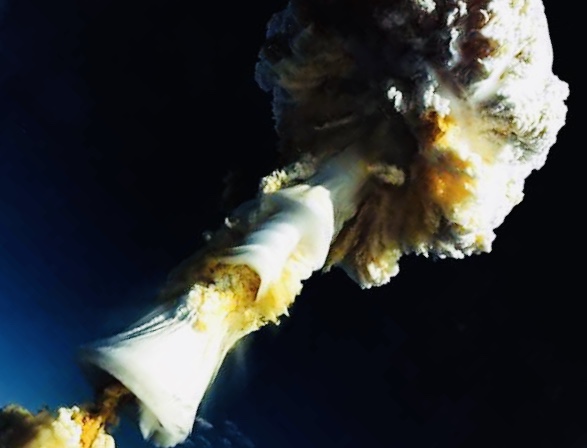
The mushroom cloud grows
Across the blind horizon
A dead gray snow falls

“There was just a continent without
much on it
under a sky that never cared less.”
— William E. Stafford / “At the Bomb Testing Site”

I live in a parallel universe of my own devising. I live most of my days in a dank cell, in the bowels of a vast complex of cells. I am allowed to write for fifteen minutes every afternoon, on the refuse recycled from the lands beyond the barrens. The pipes on the ceiling drip at all hours of the day and the walls are covered in sweat.
On occasion I hear others moaning from distant cells, but never from the cells immediately adjacent to mine. I’ve never seen any of other inmates here, only the gloved hands and truncheons of my captors. They allow me out for a day once a month. On these occassions I visit my childhood home, which is now a pile of dusty detritus and gnarled rebar. I also visit the site of my former school, which is now a massive dung heap. Really, a dung heap. A heap of dung one hundred feet long and thirty feet high now. Cattle wander about freely here since they were infected with the plague, and deemed holy beings. The inhabitants of this neighborhood have been tasked with building the dung heap into a 100 x 100 foot totem to our shantytown. The last refuge before one enters the barrens.
When I tire I sleep on a patch of rock where our library once stood. Early the next day I walk back to the complex and my cell. I love my little hole.
In this parallel world which I inhabit only the objects that become the subject of my consciousness truly exist, everything else is a ghostly simulacrum that plays on unseen film screens in theaters I don’t attend. And that I wouldn’t attend had I the capacity. And I am a capacious man, even in these lean times.
Especially in my little hole.

“So it is better to speak
remembering
we were never meant to survive.”
— Audre Lorde / “A Litany for Survival”

And he must hold on to the sink and stand firmly on his left leg because his right leg is useless. It doesn’t respond to his command all Henry can manage is to drag it along and he doesn’t dare stand upon it because he doesnt trust it to hold him up.
In this fashion Henry starts his day, everyday. He doesn’t know how he will go on. But he goes on, and the next bit is the worst part of every morning.
Henry?
What, already?
What does regret mean?
A metal machine skronk segues to a lower register followed by a thin glass skittering from the closet.
Nothing. Nothing but the black suit, white shirt, black tie and demon shoes. A glint catches his eye, and there in the corner a drunken spider makes it’s way across it’s derelict web toward a sidereal moth in its throes.
“Henry, you were such a good boy. So tender to the touch. Remember the day you discovered the Sassaby’s? All you said for days was, I am a sassy Sassaby. Oh, you were such a dream, Henry”
Henry rotates the bird cage, shakes it, places his ear to the felt pad on the bottom.
It’s not that Henry is on the road to perdition as much as he is in Satan’s bowels. And then it all begins again.

“Certainly anyone who has the power to make you believe absurdities has the power to make you commit injustices.”
— Voltaire / “Questions sur les Miracles”

The god of the godless oversees this place.
There is no lodestar here. All is coal, bituminous and gas fires. Everyone wears a sheen of black. Coal dust and gas floats through the atmosphere. The air is sharp with the tang of petroleum and machine fluids. The ground is never dry, always a thick sludge that swallows the heels of your boots and sucks them off your feet. The food tastes of petrochemicals and your sense of taste is attenuating quickly.
There are tendrils of perfume pin pricking the air and you follow that scent to the end of a street where the bodies are piled chest high. At the foot of the mound a boy with a tank on his back is spraying the bodies with the sweet scented aerosol. A moment of beauty among the nightingales. A twist of sobriety in a world full of drunkenness. This is what you live for in this world.
What the child does is what every child his age does. The aerosol not only kills the bacteria on the decaying bodies and counteracts the stench, but also hastens the decomposition of the bodies. There are many neighborhood dumping areas about the entrepôt — just like the Middle Ages, some say, back in the days of the death carts and plague pits.
There was no place left to put the countless dying and recently dead, the land would tolerate no more bodies; there wasn’t any free space. There was a constant coming and going from these dumping areas. People would come with hands and arms full of family members and leave lighter, empty handed.
The gas vents punctuate the night far into the distance. The belching stacks and fires from these vents are constant. You’re happy that what little you can see of the sky, during what passes for daylight hours these days, is not the continuous fog of your childhood.
Of late some wisps of anemic blue sky have been spotted. The weather has cooled too. There’s been some talk of a returning atmosphere, but mostly uneducated conjecture you figure. What does anybody really know about what’s happening beyond the barrens. No one is certain. Everyone that has ventured out in recent memory has never returned, and even though you’ve given thought to it, you’ve never seriously considered it. Until now.
“Hey, wake up there. Move along.” A soldier prods you in the shoulder blade with her truncheon.
“Oh, fuck off,” you say. “Miserable pig.”
“Oy, you!” A larger soldier approaches from an angle you did not expect. “Ey, fucker, move the fuck on.”
A blow to your temple sends you cantering down the street. You wobble. A couple of kids playing with garbage snicker and run. The others walking by avert their eyes and move in wide arcs around the soldiers. You run back to your room, unsteady at first but then gaining momentum and resolve. You hear the soldiers laugh as you run. You’re not worth their time and energy. You decide you’re leaving tomorrow night, after your shift. You’ll venture into the barrens, anything is better than this dead place.
“William, you’re bleeding, there on the side of your head. You didn’t tangle with the police again, did you?”
You head directly for your side of the room, past the sheet hung up between you and your mother.
“William?”
“Shut up. Shut up, please. I’ve had it with you, with the cops, with The Factory and with this god damned place. I’m going to leave. I’m heading out tomorrow after my shift. I’m going out beyond the barrens.”
You tear the sheet of its moorings. “You can have this shit hole all to yourself after tomorrow.”
The call of The Factory siren next door rattles the window. The shift is changing. Doors in the hall open and close in unison, and your mother aghast and about to speak automatically turns and leaves the room and heads for The Factory.
You stare at your broken dirty hands, gnarled from the digging, always digging. Somewhere there must be more, something different. It can’t all be like this, you think.

“It failed. The whole world failed at it. It could have been so brilliant. How strange of you not to feel sad.
Who knew life could be so awful.”
— Alice Birch / Revolt. She Said. Revolt Again.