ash for you

Memorable Stuff I Read This Week

There is a fine line between losing yourself and finding your deepest truths. Sometimes there is no line at all.

— Laura Killingbreck / “Into the Wind” / Bicycling


The frequency with which bicyclists are hit on the road makes me believe it is a rite of passage and that not having personally been hit is an indicator that I have yet to achieve true bicycler status. This inference might stem from humanity’s positive spin on suffering: battle scars earn us glory.

— Tree Abraham / Cyclettes


you entered the dwelling place of dead tenderness alive
and in each step you recognized
yourself as an enticing answer
the world hasn’t changed from ash for you
nor has anguish crucified itself

— Tristan Tzara / “Speaking Alone”


In the labyrinth of memories, I often ask myself how much are they in flux, what mattered when, and how much has evaporated or changed tonality. How true are our memories?

— Werner Herzog / Every Man for Himself and God Against All


Besides, nothing inside me is ever certain or
In agreement with my self … Beautiful hours
Belong to others, or simply don’t exist.

— Álvaro de Campos / “Three Sonnets”


. . . only moving / does it have a soul.

— Pablo Neruda / “Ode to Bicycles”


In that moment I understood: Joy was its own form of power. It flowed through people, through landscapes, through wind and motion. It radiated from the body and was stored there, too. Joy was limitless and easy to share. After all these miles, I’d arrived somewhere.

— Laura Killingbreck / “Into the Wind” / Bicycling
What I’m Listening To:

I’m just dressing for the weather,
and the forecast is for pain

— Arab Strap / “Strawberry Moon”
Posted in Writing | Tagged , , , , , , , , , , , , , | Leave a comment

wisp of menace

agitator cola

i love me an agitator cola—drank many thru the years—during the revolutions and convolutions of martial law and coups—upon the ferment fringes, the ferry boat frivolities, and mere highlighter battles with the brittle page—a brush with agent coils and deadbeat plenipotentiaries—many a casual contrainsurgency compote consumed—electroplated and anodized death from above—daisy-chained and strafed—a full life of fingermark detonations and finicky trigger fingers—oh, what a feeling, that subtle wisp of menace before the darkness—i’m the hand of the man who leads—the hand of the man u voted for, or supported on his rise—i’m ur hand by transitive property—aren’t we a peach?

What I’m Reading:

The end is coming. I picture a radical turning away from thought, argument, and image, not just an approaching darkness in which certain objects can still be felt, but a condition where they no longer exist at all, a darkness filled with fear, with imaginary monsters.

— Werner Herzog / Every Man for Himself and God Against All

Posted in Writing | Tagged , , , , , , , , , , , , | Leave a comment

into the murk

Charles River Murk

He composed a text to her, intending to say: “I’m going to be a strong arm robber,” but the auto correct produced: “I want to be s thong arm tobber.”

She responded: “U mean a strong arm fibber?” She had turned off her autocorrect months ago, confident in her speed and accuracy.

He responded: “no a string arm ribber.” His fused thumb again unable to hit the mark.

She threw her phone in the river from the Mass Avenue Bridge. She’d always wanted to see something she’d thrown disappear in the Charles River murk. 

A few yards later, she dove into the river. Nonplussed, he watched her disappear into the murk.

What I’m Reading:

Riding downhill can be a serene exhilaration after a strenuous climb. But it can also represent the decline after a peak experience. I don’t want there to be an ultimate summit. Instead, waves. Crests falling into vales with a momentum to carry me down and on back up ad infinitum.

— Tree Abraham / Cyclettes

Posted in Writing | Tagged , , , , , , , , , , , , | Leave a comment

never look back

[straitjacket lies . . . ]

the straitjacket lies we tell:

undesirable midriff chicken thieves
the long hock of american frippery
gentlemen strategists and exponents of farewells to rooks and frontispieces
filaments upon the dockyards of miracles
an inexorable western expansion
employed by eugenecists of privilege
and destruction

uneven accountability for our past
never look back
no reiteration required

What I’m Reading:

The real ogres are the ones who are complete gentlemen.

— Matthew Thomas Meade / “Sunshowers” / Strip Mall: Stories

Posted in Writing | Tagged , , , , , , , , , , , , | Leave a comment

a juvenile melophile

comfortable blandishments haiku

a murmuration
a juvenile melophile
a twisted headpiece

What I’m Reading:

I always wanted to defend outposts others have already abandoned.

— Werner Herzog / Every Man for Himself and God Against All

Posted in Writing | Tagged , , , , , , , , , , , , , | Leave a comment

the devil’s williwaw

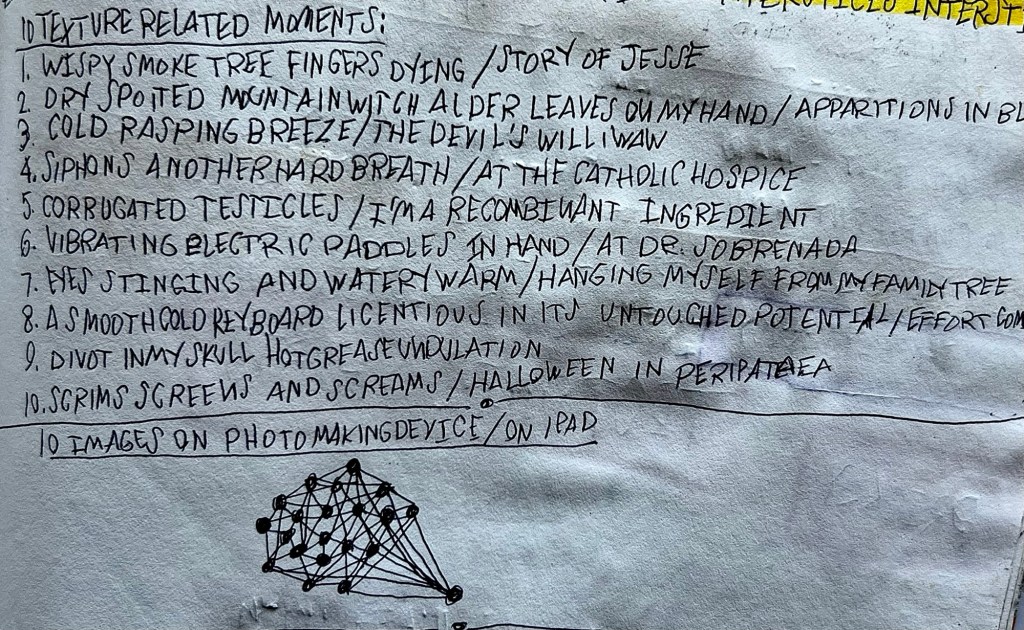
10 Texture Related Moments in a Frou Frou Life

1. Wispy smoke tree fingers dying / story of Jesse.

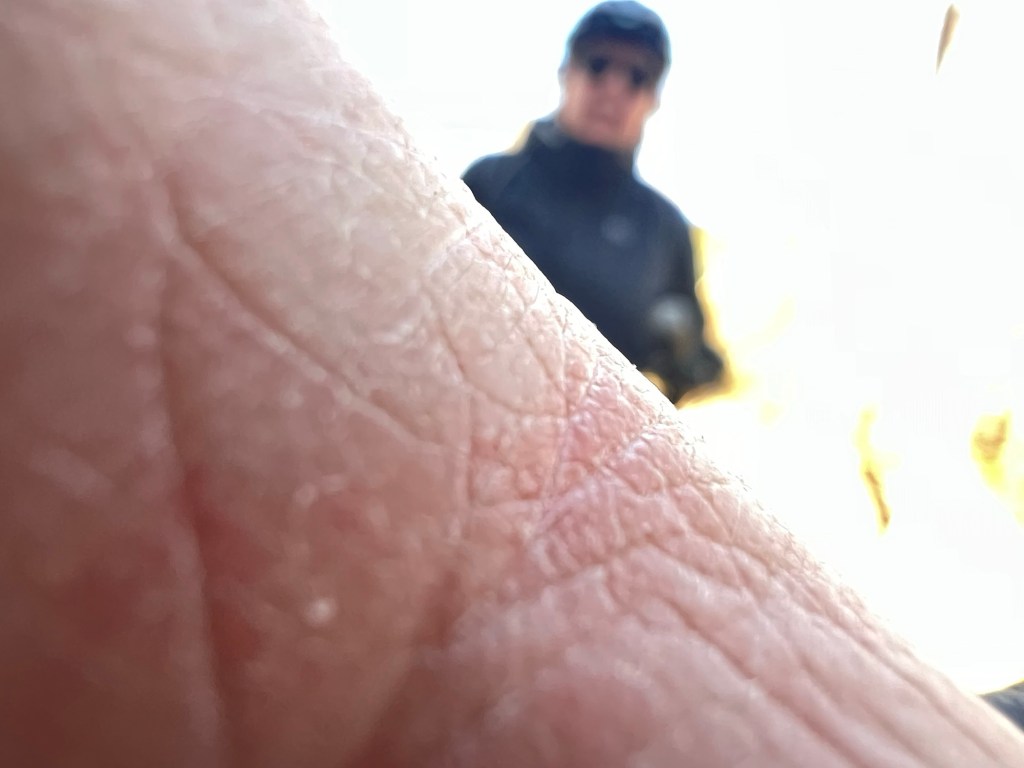
2. Dry spotted witch alder leaves on my hand / apparitions in black.

3. Cold rasping breeze / the devil’s williwaw.

4. Siphons another hard breath / at the Catholic hospice.

5. Corrugated testicle skin / I’m a recombinant ingredient.

6. Vibrating electric paddles in my hand / at Dr. Sobrenada’s.

7. Eyes stinging and watery-warm / hanging myself from my family tree.

8. A smooth cold keyboard licentious in its untouched potential / effort combover.

9. Divot in my skull hot grease undulation / gritty goat-skin hair while suckling Zeus.

10. Scrims screens and screams / Halloween in Peripataea.

What I’m Reading:

Once I saw the city 
of God reflected 
in a freak shadow 
the sun cast. I 
thought life complete, 
tight, happiness.

— Peter Gizzi / “The Winter Sun Says Fight”

Posted in Writing | Tagged , , , , , , , , , , , , , , | Leave a comment

in this (my) neighborhood pt. 59

What I’m Reading:

Cycling was a way of staying in motion and coming home to myself. When nothing else made sense, I could go—dissolving into breath and sky—and let the wind rearrange me.

— Laura Killingbreck / “Into the Wind” / Bicycling

Posted in Writing | Tagged , , , , , , , , , , , , | Leave a comment

woman among men

Memorable Stuff I Read This Week

. . . “Dogs become dogs again and snap at your raincoat; potholes become personal.” It might also be said that a city becomes extra-cityish, more seething and carnivalesque, from the vantage point of a bicycle. Danger is a sensory intensifier, supercharging the scenery, making everything appear volatile and alive.

— Jody Rosen / Two Wheels Good: The History and Mystery of the Bicycle


Jan.22.2022
The sky is crooked at my feet. I’m tired
of someone else’s dying. I’ve lost two
pounds because I’ve been chewing rain instead
of swallowing it.

— Victoria Chang / “Today”


. . . and perhaps most importantly, our impending doom leaves us feeling paralysed. If we’re already screwed, then what’s the point in trying? Far from making us more effective in driving change, it robs us of any motivation to do so. I recognise this from my own dark period when I nearly walked away from the field entirely. I can assure you that after reframing how I saw the world, I have had a much, much bigger impact on changing things. When it comes down to it, doomsday attitudes are often no better than denial.

— Hannah Ritchie / Not the End of the World: How We Can Be the First Generation to Build a Sustainable Planet


I understand:
for years, perhaps, you have lived
underground. Handling only
darkness, you have not become
accustomed to it. You want to get out.

— Everette Maddox / “Welcome Home”


A bicycle in traffic must be predictive to the point of clairvoyance, must know the cars better than the cars know themselves, must understand their motivations and their common blunders. Cars don’t always signal their intentions. And cars aren’t always nice to each other, though they usually show each other some respect in deference to the damage they can do to each other. They are like important men in conversation with other important men. Bicycles are sometimes kindly accommodated by cars, often ignored, occasionally respected, sometimes nervously followed, and frequently not even seen. In this sense, riding in traffic is not unlike being a woman among men.

— Eula Biss / Having and Being Had


But in spite of these riders who prize the utility of two wheels above its art, riding a bicycle is one of the few street activities that can still be thought of as an end in itself. The person who distinguishes himself from that purposeful crowd by conceiving of it as such should be call a cycleur. And that person – who has discovered cycling to be an occupation with no interest in ultimate outcomes – knows he possesses a strange freedom which can only be compared with that of thinking or writing.

— Valeria Luiselli / Sidewalks


But for those of us who have bicycling in our bones, the arguments against it are worse. Bike riding can kill you, but to trudge through your days without biking-that’s no way to live.

— Jody Rosen / Two Wheels Good: The History and Mystery of the Bicycle

What I’m Listening To:

Send in the clowns
Send in the army
You want to be American
Get your gun
You’re so free
You can shoot me

— Kim Gordon / “It’s Dark Inside”

Posted in Writing | Tagged , , , , , , , , , , , , | Leave a comment

in this (my) neighborhood pt. 58

What I’m Reading:

A cycling life begins in a blaze of glory.

For hours or days or weeks, you still don’t know how to ride a bicycle. You wobble and lurch and wipe out, locked in a pitiful struggle with the pull of gravity and the weight and waywardness of the obstreperous metal machine. Then, suddenly, you are breezing along a road that stretches toward a limitless horizon.

— Jody Rosen / Two Wheels Good: The History and Mystery of the Bicycle

Posted in Writing | Tagged , , , , , , , , , , , | Leave a comment

above the ottoman

The Pivot Point (redux)

I’m not really hungry just now… she wrote longhand, the first time in weeks, in her journal.

And she thought that odd because she’d been ravenous all throughout her illness, and hadn’t written a thing, but now she felt a shift. She didn’t necessarily like what she intuited lay ahead, but on her life unspooled. A shrunken head, lifeless and truncated, appeared before her again. It floated and shimmered — a self-contained Fata Morgana, hovering above the ottoman in a slow pulsating light. The heavy odor of ammonia filled the room.

“I am the shrunken head,” she said, “and the shrunken head is me.” 

She tried to suppress a cough but it scratched its way up her throat, and in a paroxysm she expelled a smaller shrunken head — golf ball sized — which rolled end over end down the marble hallway and eddied below a gilded full length mirror. 

The sound of a theremin swelled from beyond the living room and a small red spot of light framed the smaller shrunken head.

This would be her pivot point in life. The one moment by which she would measure the rest of her life. There would be her life after this shrunken head moment, and all the other inconsequential living she’d done up until this singular moment.

A ululation came from the smaller shrunken head —  at first like a sweet distant trill, as if she were looking for scarlet tanagers in a clearing at the edge of dark woods — but the sound became shrill as it grew louder. And the bird broke out of a thicket and headed for her, with every flap it transfigured itself: first flap, from scarlet tanager to a pileated woodpecker, with its second flap it became a crow, and with its third flap (making up the distance to her with great speed) it became a red shouldered hawk, and as the shrill ululation began to sound like a fire alarm the bird transmogrified into a turkey vulture lancing at her eyes with its talons. 

In this manner she awoke to the original, larger, shrunken head hovering above her bathed in a golden light. She swatted at it, but it was just beyond her range. She let out a meek, “fuck you,” and placed the pillow over her face. 

“Today you’ll find and bring me the most beautiful starfish in the world,” the shrunken head said.  “I demand it of you. Go!” 

After her long illness, it’s what she felt compelled to do…

What I’m Reading:

“It’s confusing. It’s an absurdity. But hardly the only one: We fall in love. We know we are going to die. We do strange things like make art, and dream, and put each other in prison, and cut ourselves when were depressed. And try to be kind when we can.”

— Andrew Boyd / I Want a Better Catastrophe: Navigating the Climate Crisis with Grief, Hope, and Gallows Humor

Posted in Writing | Tagged , , , , , , , , , , , , | Leave a comment