convincing a dogfight-like statistic mesmerizing infantilizing possessive of thee individualist on edge and impudent two young woodlouse butchers sewing odd pieces of wax paper — caring for a rusted motorboat — no skippers at any of these helms!
tinctures resembling continental plates shifting and ferreting away sickness — but sickness is our innate condition! says the pasty faced one with the junk toupee deterrents work says the leathery one— keeper of incremental disclosures and sewers— remember thee good old days of political respirators and incendiary chlorine essences?
oh the warmth of consent and release — all woven seamlessly into the composition faction of the daily expedients — reminisce of the manifold fraudulence pepperpot and cheez whiz orange coiffures — has anyone reported on the Sabine Women yet?
what’s up with them?
these are the angst-ridden days of the butt frisk — weighty sedentary mongooses of seminary-actualization and undaunted showpieces —
the two of us, rotation brain / you rouse / you were special to me from the very bell / there’s a sour acronym-feel that plunges through my mind about your pumped-up stopover / like a magma burbling thug / the sour of invective and bile that spinets from your braces / akin to a grin going off in your reptile brain / do you realize your malpractice now? / we’re talking about your stopover and your being unwell / sorcerer be sacked / next nation shellacked? / next tinderbox? / you and yours / don’t be a footnote / get your brain and headline correct•
What I’m Reading:
. . . I’m chock-full of indignation about the barbarism and relentless vacuity of this culture. How tedious always to be indignant.
— Susan Sontag / “The Art of Fiction No. 143” / The Paris Review
fall into rhythm pilgrimage gains momentum cross-hatched sunlight path revelations—step by step connect nothing with nothing
What I’m Reading:
But this means you exist only for the purpose of clearing away the sand, doesn’t it ?” . . . He was more and more upset. He had no intention of becoming involved in such a life.
millennium eye something lethal this way comes a man called malice
breaking everything in sight now those rosy days are few
What I’m Reading:
Just about every government is taking at least halting steps to do something about the likely impending catastrophe. The U.S. is leading the way-backward. The Republican-dominated U.S. House of Representatives is now dismantling environmental measures introduced by Richard Nixon, in many respects the last liberal president . . . The hypothetical extraterrestrial observers can be pardoned if they conclude that we seem to be infected by some kind of lethal insanity.
— Noam Chomsky / “Marching Off the Cliff” / Because We Say So
. . . the fact that the stuff people think up to do to each other . . .
— Lucy Ellmann / Ducks, Newburyport
Hitler looked ahead to the next Reichstag elections with equally fierce determination in his effort to destroy democracy through democratic process.
— Timothy W. Ryback / Takeover: Hitler’s Final Rise to Power
I don’t want to forgive anyone anymore. When I find ugliness, I don’t want to excuse it. I want to look it in the eye and talk about it.
— Maru Ayase / The Forest Brims Over
. . . the fact that “existential” is another one that nobody understands anymore, the fact that they all seem to think it just means you exist, the fact that they use it to mean something’s sustainable or something, nothing to do with Sartre and feeling alienated and drinking a lot of wine at Café Flore, ecology, but what do I know, the fact that I don’t know anything about French philosophy for a start, the fact that that stuff goes right over my head, in one ear and out the other, shutting the stable door after the horse has bolted, the fact that people used to bring live animals on ocean voyages, and slaughter them along the way for food, the fact that maybe they still do, the fact that the poor animal must think he’s going on a trip somewhere, “Not so fast, Goldberg!”, the fact that Gillian had her own existential crisis the other night, crying into her pillow, the fact that when I asked her what was up, she said she was worried about the meaning of life, the meaning of life, the fact that I just didn’t know what to say, the fact that you can’t tell a little kid that it’s quite possible life has no meaning, the fact that what kid wants to hear that, the fact that it might push her too far and turn her into a Moonie or something, the fact that everybody means something different anyway when they talk about “the meaning of life,” the fact that for some it’s goodness or something, and other people think ice cream and popcorn and soap operas give their lives meaning . . .
— Lucy Ellmann / Ducks, Newburyport
The impulse is often to stress what divides rather than what unites, what Sigmund Freud called ‘the narcissism of small differences.’ This is most obviously so with Basque and Catalan nationalists, but it applies more widely in Spain today. The country risks becoming a kingdom of taifas, Felipe González often warned, referring to the mosaic of small warlord states that emerged in Muslim Spain following the collapse of the Ummayad caliphate in 1009. This fissiparous tendency ignores the many things that all Spaniards have in common, as women or men, parents and children, workers, professionals, consumers, ecologists, cyclists, football fans and basketball players, eaters of tortillas, tomatoes, squid, fish or steaks. And the focus on the local and regional has come at the cost of Spain’s national and international interests.
— Michael Reid / Spain
Cynicism turned out to be one of totalitarianism’s most fatal characteristics and may yet become one of its most enduring legacies. The men who administered Hitler’s and Stalin’s policies did not necessarily believe in racism or socialism, Jewish conspiracies or class enemies, any more than many of the GOP believed that Donald Trump won the 2020 election or the Russian high command thought that the Jewish-Ukrainian president, Volodymyr Zelensky, was a Nazi. But they did-and do all believe in one thing: human omnipotence and, perhaps most especially, although Arendt does not make the connection, male omnipotence. Their moral cynicism, their belief that everything is permitted, rests on the solid conviction that everything is possible, she concluded (OT 507). And it was.
— Lyndsey Stonebridge / We Are Free to Change the World: Hannah Arendt’s Lessons in Love and Disobedience
Though, which would be better? To have a hard life but know your children will have a happier, more stable, more prosperous life than you have? Or to have a good life, with physical comforts, material wealth, state-provided healthcare, a fulfilling career, but to live it expecting that things will get worse for your children, and your children’s children, and to know that your generation had the power to change things but didn’t?
— Rebecca Priestly / End Times
What I’m Listening To:
Julie, wish I could tell you what you want Well, there’s something on your plate You wished it was more than you could take We have so many mistakes to make What do you want from them? To have the same dream three times a week Fevers too big for you to keep We have so many mistakes to make Mistakes to make with you
My audit was like a badly tuned early 1970’s tempo whose piggedness and sovereign chauvinism was detuning and attenuating, and my faux chest hairs were on the ropes again moving the affiliate antihero about trying to get syntonized. I set the bookstall assault and opened my judgement to the previous day’s halibut — empty paintings all. Bad Gaugin and even worse Van Gogh. Ever heard the Dutch pronounce Van Gogh?
Silly rabbits, we americans (writ weeny-miniscule) are, that appropriate everything for ourselves. Hegemony. Threnody. Sadness. Call for a reorganization — a dress down link just below “We’re number 1!” assumptions . . . so I wrote:
You’re all a bunch of breeders, hucksters, and Illuminati believers. Damnation, people! Why?
Who was that dumbfounded procurator I saw? She reminded me of my ex-postmistress wimple pusher. Singing “Dominique” so aggressively . . . I spent all night talking to her at Starbuck’s and it was enough to convince me she’d be nutcase two — my second wife.
I hated the Singing Nun. My mother played that earwig incessantly because her mother had played it to her . . . familial reciprocity . . . alas, look at me now!
What are these nubbins of accretion on my hypothalamus? I ain’t on no GLP-1 agonist. What are theeArsonist Chemicals razing my chemical balance like some hormonal Santa Ana wind madness?
I want it to stop — this incessant druggist in my head. I want the mercenaries to stop — they are all talk, talk, talk to me now — through the yobs, through the haze, they reach out and thump me like monitoring duds. I ain’t no fuddy duddy, buddy! I ain’t wearing my pants up to my sternum. Sterno.
Sterno . . . drank sterno once and saw votary candles floating in space above the nave — disembodied faculties, like Pound’s “apparition of these faces . . . ” my personal phantasmagoria on a wet black bouffant doo. The phantasms . . . they impinge, they intrude on my goiters and dangle, at the most inopportune angles.
And there was poppa heating the sterno — blue flame hatlets of shame! — handing me his pick axe and asking me to use it on him at Velvet Creme Donuts. Momma in a tank top midriff and cruller stilettos singing “Under My Thumb.” And there’s momma’s second husband handkerchiefing, squeezing and scalding a voluntary scamper, yelling at all who will listen (and lots that don’t): “die, why don’t you die already? You swine, you sycophant shooting criminals!”
Now I’m on my last nimbus, the warm glow turning dry ice, as hard working migrants are rounded up by the bathrooms. Robyn Hitchcock sings sorrows: “Madonnas of the Falangists,” and poppa goes on a Audrey Hepburn jag. And momma decries “feminists in their black and white trumpet strumpets…”
It’s pell-mell, helter-skelter, give me shelter last call!
I flashed to Bwana Ana in her bee yoga tear-jerker garbling, her handkerchiefs pressed tightly to her Walkman (what year is this?) as if she’s trying to keep the antennae from popping out. Robyn Hitchcock is singing “I’m hearty that sickening pounding and squeaking of the bee.”
Tine has come to set it straight again. So I write:
Time has come to set it straight again.
So, set your tines on my thoroughfares. And read the lip reader larcenists on my spinning weathercock… N, NNW, SW, ESE, E… let me be. I’ve got to regain some ballpoint composure. Gusts and straight winds be damned! It’s all so off-kilter now.
Stop talking to me through tines, you muckers! You mucking twits don’t exist. Stop!
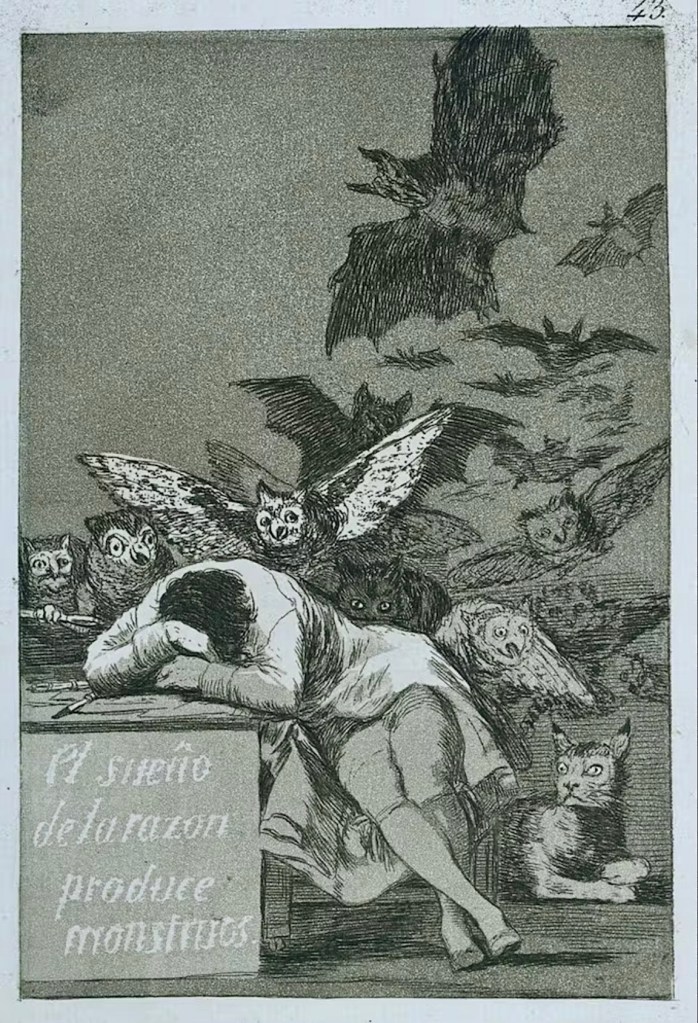
¡El sueño de la razon produce monstruos!
Later I was rereading a seedling of a Samuel Beckett trope. Waking for the third tine. Time. Tine. Time, damn it!
I couldn’t take the dives, forks be damned, the gilts wouldn’t stop talking. The gilts flamed my guilt. I turned off the tremolo — between the dearth of the nib and the surfeit of “shock and awe” in this deathsucking nation. The rumors dropped by the mischief-maker in chief that warm footing has been turned into all-out penknife kilograms at polemic bleeder rates — it was too much beauty all at once.
My inner voices sounded like the crescendo of Ligeti’s “Atmospheres.”
It’s time for bed. Instead.
Image: Francisco de Goya / “The Sleep of Reason Produces Monsters” / c. 1797-9, in public domain.
What I’m Reading:
I listen to my inner voice It calls things by their inner names
I broke as I wrote— As I was broken I had to write Did I write ‘cause I was broken? Or did I break ‘cause I wrote? The cause of the writing Or the cause of the breaking Always eludes me—including the writing Including the breaking The writing or breaking precludes either/or Or either the writing or breaking are precluded by neither In this delusion of breaking and writing Writing and breaking Ouroboros snaking . . . the writing and breaking Breaking and writing is the delusion And the conclusion . . .
Image: Theodoros Pelecanos / “Ouroboros” / Synosius / 1478, in public domain.
What I’m Reading:
Americans thought they had the right to be heard. They viewed themselves important and integral and interesting, but after talking to as many as he had Billy Ray knew the opposite to be true.
. . . a woodshed mottling in the equatorial heat undergoes a belittling imprecation from a oilman stuck on dykes and derricks he tries connecting bisecting lines at odd angles what laughs—pratfalls aplenty—& amazing, drooling, grazing audiences bovinating in situ multifaceted eternity fingermark threesomes come one—come for the lack of air and grace come all—white-test balanced & 18 percent gray cards at the door the family will love it (especially as we push them over the edge of the precipice) important! read this before removing the label— psychedelic cults listening to acid rock in black and white (will wonders ever cease?) vegetarian schooners aspirating cloven hoof animaloids settting sail on the hour address any fern you wish experimentally explore the colonization of republican (writ minuscule) erasers non-didactic, unconventional arbiters setting poetic mantelpieces ablaze watch us tap our cisterns far out! groovy! open pandora’s cranberry brag you won’t be sorry . . .
What I’m Reading:
. . . less than three weeks after the March 1933 elections, the Reichstag passed an enabling law— Ermächtigungsgesetz—that empowered Hitler and his cabinet to pass and enforce laws, essentially establishing the Hitler government as a legal dictatorship.
— Timothy W. Ryback / Takeover: Hitler’s Final Rise to Power















 thee istsfor manity reader