Don’t talk to me about bloody urine, son! There were days when I’d drink ground glass shakes and piss blood clots all day.
I’d pee bloody streams incarnate!
So go away with your complaints of I’ve got discolored urine, dad. I used to piss shards, lad.
Shards!
“How do we begin to make sense of our own complicity, however reluctant, in this nightmare? I know that I’m complicit; my hands drip crude. Hell is murky.”
It’s not the life of a flea tamer or flea circus operator that I strived for—but it’ll do for now.
I look down on the swaying treetops—instead I see a roiling ocean—the wind hypnotic.
A central air conditioning unit just below my balcony—it says it wishes to condition my hips. My condition will surely be one of rendition from frothy blades.
My past has become pointedly polyptotonic, and the polyptoton will morph into antanaclasis … antanaclasisism—ant, ana, clasis, ism—break, break, break this off!
An exercise in moving my hand across the page—or thumbing tippy tips on gorilla glass—becomes existential glaze.
Mark-making on empty spaces—sometimes proscribed by lines, sometimes not.
That is my life. Just saying. I’m here.
“I asked if / I could survive knowing that not everything has a reason, that not everything is capable of or interested in reason / Nothing answered.”
These were the first words Garcilazo spoke when Maria finished drilling the hole in his head:
This is plundergraphia. This is Flarf. This is Newlipo. This borders on Google-sculpting. Remove me from myself and then take yourself out of my body. You’ve been inhabiting my body far too long. I need an exorcism… You… you are a trapeze artist with a fear of heights and sick with vertiginous desires, and I require nothing of you — but I want you at my disposal. I will dispose of you when I tire, but I’ve tried too often to depose you without first taking your deposition as it relates to your position in this disquisition; and yet I never inquire as to your disposition on my position…
Maria repositioned herself on the recumbent couch — really more of a settee — cradling the bloody hand drill in a wad of Bounty. And Garcilazo continued:
… reconnoitering of your superstitions and lack of interstitial indecision. I’ll decide and you’ll suppose that I’ll undertake a reconnaissance of the imposition of superstition of the implications involved with trepanation. Then I’ll help you trepan yourself, after which you will trepan me again.
“That’s a no. Not today. Not ever.,” Maria said.
***
“Trepanation is the process of removing a disc of bone from the skull. While generally regarded today as a barbaric operation exemplifying the benighted state of medical practice in medieval Europe, to its few adherents trepanation has actually solved one of the basic dichotomies of human existence: the split between mind and body. While evidence of trepanation can be dated back to 3000 B.C., its advocacy as a direct psychological shortcut to serenity is a little-discussed tangent of the psychedelic movement of the 1960’s.
The first contemporary European to drill a hole in his head for the purpose of becoming “permanently high” is Dr. Bart Hughes of the Netherlands. After three years of research into what he has termed “brainbloodvolume” and its effects on the mind. Dr. Hughes administered his own self-trepanation on January 6, 1965…
A stubborn literal-mindedness has yielded a novel if largely overlooked theory: that the third eye of ancient mystical lore is an actual hole in the human cranium.”
— Stuart Swezey, Amok Journal, 1995.
***
The following Saturday at The Metropolitan Museum of Art, a few days before Garcilazo was hospitalized, this:
“I’ve never seen anything as atrocious as this. How is this art?” He seemed to be pleading with Maria to leave.
“Well, why isn’t it art?” she said, “the artist has created this as a work of art. Why do you think it’s not art?”
He turned to Maria and looked at her somberly. “Do you consider this — a great white shark in a clear tank of formaldehyde a work of art? And who is this Damien Hirst fuck, anyway?” He shifted his jacket onto his right forearm holding it as if he were an expectant waiter. His judgment would be swift and permanent. Predicated on her opinion, their relationship would either whither or move on, that’s what she intuited by his demeanor. She found his earnestness disconcerting. There was something petty and pernicious about the twist on his face.
According to his affect she was the biddable one. He, somehow, would make some pronouncement here and she’d either be out with the trash or still his sister. Nausea seeped in.
***
By the end of the week Garcilazo was malingering. He had a well known tendency to simulate symptoms when month end work was due. He’d be out of the office most of the day injecting himself with q — actually taken in this light, he was malingering in honest fashion but he was bringing it on himself. The symptoms did end up being real but he was causing his own sickness, and only at the end of each month. Did he do this to himself away from the office? No one ever found out. But over time he turned an off color, as if his skin was striated with loam and it started to slough off at the edges of his shirt cuffs. And in the full course of time, one day when Mr. Semplice went in to see him, all he found was a mound of skin on Garcilazo’s seat. Had he turned into this? Or was this his parting gift? No one at the office ever knew.
“What am I to myself that must be remembered, insisted upon so often?”
A note stated that his left arm was touring the Costa Brava, visiting the sites where Joan Miró sketched a biomorphic vision or two—while the right arm was tracing Darwin’s “finch routes” through the Galapagos.
Over the next weeks the arms sent him postcards, twice-weekly, as they extended their travels to the former ice fields beyond Ilulissat, slowly paddled the Zambezi River, and covered portions of the Annapurna and Appalachian Trails. The arms had a fruitful summer.
Back at home Hortensio became well acquainted with the adroitness of his feet. They were both usurpers, ever trying to make him realize the superfluity of his arms.
Daily they harangued him to break off relations with his peripatetic and prodigal arms: “The fortune they are spending! Their wanton disregard of your dexterity!” was the constant cavil.
At his feet’s prodding, Hortensio wrote both arms a note at their next appointed stops—Iquitos for the right arm; Petropavlovsk-Kamchatsky for the left—telling them not to bother returning home: “Your services are no longer required.”
At the right foot’s prompting, Hortensio filed a complaint with the State Department which prompted an alert from Homeland Security. “That’ll fix ‘em,” the left foot said.
His arms are wandering rogues to this day.
Detail of Louise Bourgeois’ “Cell (Hands and Mirror)” / 1995 / ICA, Boston
“Its face was like the face she had seen in some medieval paintings where the martyr’s limbs are being sawed off and his expression says he is being deprived of nothing essential.”
Proficient in “metaphoricals,” but lacking in “metonymicals,” it was decided he had some finesse for the “synecdochicals.” It mattered to no one on the staff that they were bastardizing the terms in this official report they were collating, but someone had to get rid of that little bastard language “prefigurator”—no matter how many neologisms they cranked out.
“Norms was norms,” and this non-normative fellow could not stand—would not stand—in the department!
So they devised a plan to spike his broccoli sprouts with psilocybin bits—that would fix him for good!—before he presented at the symposium.
So much for his disquisition on Thee Synergies of the Literary Fruits of Charles Bukowski and Judy Grahn: Thee Literary Love Story. It was destined for doom, his presentation, because of his “turgidity” and “floridness”—and his altered state of consciousness.
But the talk was especially memorable as he waxed aphasic (Wernicke’s) occasionally spouting something about ladybugs, Blind Lemon Jefferson, and a case of plantar fasciitis. There was bafflement among the attendees—worried looks—but once he summed it up by saying:
“Baby Gongas are fierce … harrumph … hooray!”
To the departmental staff’s dismay there ensued a thunderous 10-minute long standing ovation.
The moral here is … wash and watch! your broccoli sprouts—and Baby Gongas always win the day!
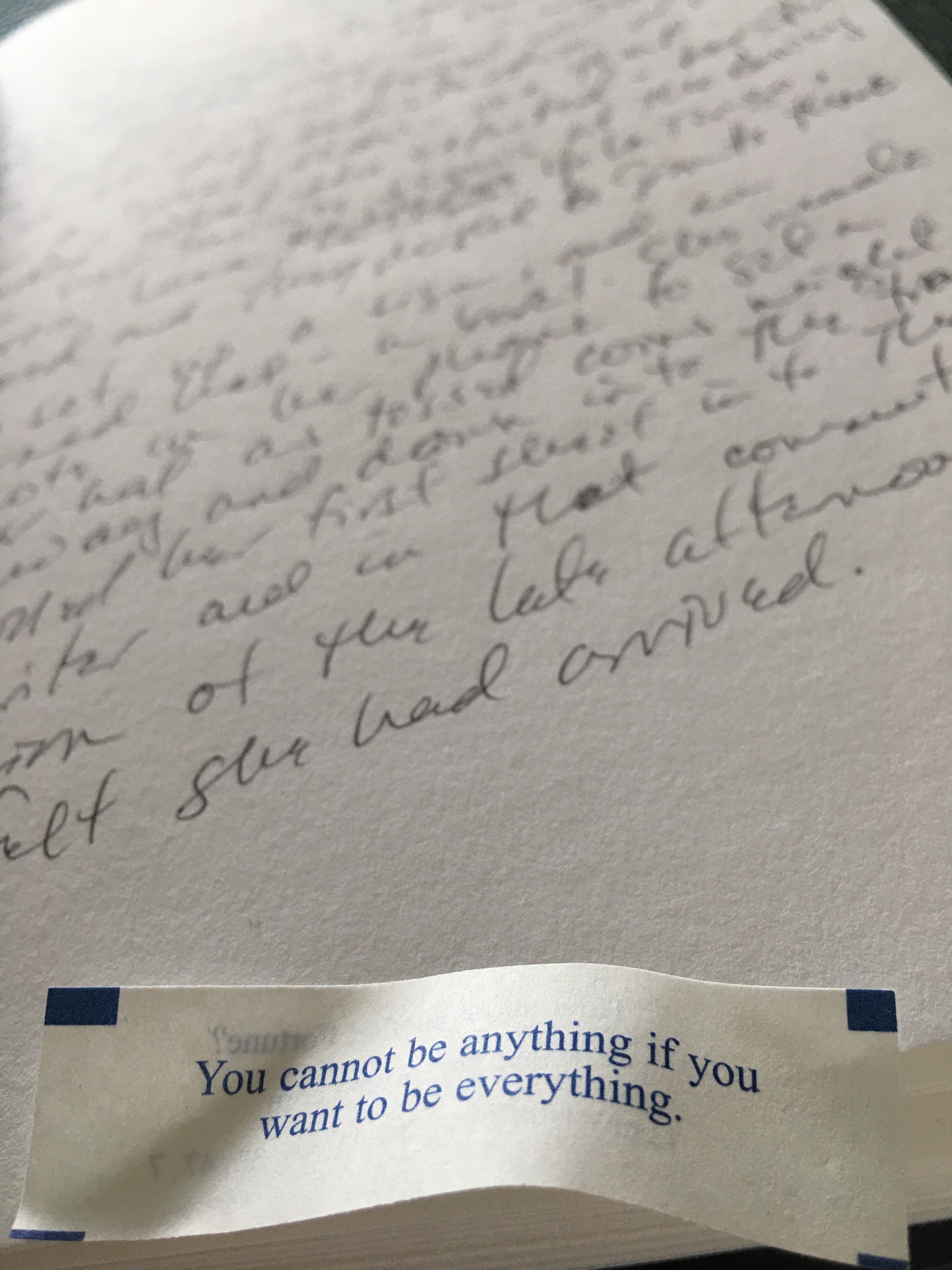
You Cannot Be Anything If You Want To Be Everything
In her dream she was at a garish fairground carnival under a cloudless dayglo blue sky. She was separated from her parents. She panicked. She was lost in this strange loud place. Carnies barking from the fringes — fleeting glimpses of them as the crowd momentarily parted — snarling mouths with spittle teeth in flashes between elbows and tilting towers of cotton candy.
A dry tongue mouth in the midday sun and sweat. She reaches for the water bottle she didn’t know she had, and there it is full of a thick pink liquid. Then fear seeps in from her vignetting field of vision — someone is trying to poison her, and she can’t find her parents anywhere in this whirlpool vision aflame — only booming music and the sharp screams of overexcited children.
It becomes clear to her she’ll never see her parents again. The thirst is overwhelming but she can’t drink the pink liquid. She knows viscerally that it is poison. She needs a drink. Her head is like the puck in the High Striker game — a shrill, insistent, “Step right up,” keeps looping in her ears — and someone continually pounds the mallet on her head as if he has something to prove to his cheap girlfriend. Every strike, a deeper guttural concussion exploding deep in her brain stem. Alarms go off.
The first waking words she hears from the radio are: “You cannot be anything if you want to be everything.”
And this is the instant her restive head settles and the headache which has been her sole companion for the last three days melts away. She says to the cat purring at her side, “I know what I need to do now, Antigone. I am going out with mother’s old typewriter, ribbons, and plenty of paper and compose lines for a living. In this way I’ll make a new life doing what I love. You see, Antigone?” The cat stops purring and shifts away from her mindless, fidgety, petting. “Yes, that’s it,” she says.
Later that afternoon, after quitting her brokerage job and leaving the managing partner mouth agape — incredulous and alarmed that his best broker is walking away from a six figure salary, and having talked him out of a Marchman Act call — she sets up her new workspace.
She sets up at the center of the Bowery station platform. She places the Underwood Noiseless Portable atop two overturned milk crates — draped by an elaborate antimacassar made by her great-grandmother that retained the oiled indention of her great-grandfather’s death head — to this she adds a low slung lawn chair.
The J and Z trains stop here and for years it has been her favorite subway stop because it hold the promise of seeing a good show on the way in. And on the way out it is tinged with a sense of great satisfaction of having seen a show that exceeded what she expected. She’d seen some of her all time favorite shows at the Bowery Ballroom: Lou Reed. Luna’s farewell show (before they came back a decade later). Yo La Tengo numerous times. The Sun Ra Arkestra. Sonny Rollins. The Butthole Surfers. Mission of Burma (on their comeback). Le Tigre (no, wait, that was at Irving Plaza…) no, not Le Tigre, but Kathleen Hanna’s other incarnation The Julie Ruin (yeah, that’s right). They Might Be Giants. So many great shows here. This must be the place.
She sets up a sign that reads: “Will Compose Poems And Stories For You.” She throws out a used beret she picked up at Goodwill. It entrances her for a moment. Then she quickly makes a note on her phone to get a deeper, more voluminous, hat as tossed coins might roll away onto the tracks.
She rolls her first sheet into the Underwood in that transient confusion of the late afternoon commute. She has arrived.
“To think that the masses of refugees fleeing food shortages and clean water caused by global ecological disaster would find compassion anywhere their desperation drove them was absurd … on the contrary, we would soon see man’s inhumanity to man on a scale like nothing that had ever been seen before.”