
January Reads in the Rearview
(My micro-reviews also appear at goodreads.com)

Noam Chomsky / Requiem for the American Dream
Did not see the documentary this book is based on / companion to—but any Chomsky is essential Chomsky. Spot on dissection of / rumination on our economic-political reality. (2017)
“… concentration of wealth yields concentration of political power, especially as the cost of elections continues to skyrocket. There is the shredding of the democratic system by the rapid increase in the ability to just buy elections.”

José Revueltas / The Hole
Expecting something more on the Camus-Beckett axis, but has more of a Genet feel to me. Good, quick read. Imagine Sartre’s No Exit in a Genet jail which happens to be in Mexico.
Underplayed. Overhyped. Worthwhile. Read the Enrigue “Introduction”— which is quite good, afterward—form your own opinion first. (1968)
“Life was one long not knowing anything at all: not knowing that there they were in their cage, husband and wife, husband and husband, wife and children, father and father, sons and fathers, terrified, universal apes.”
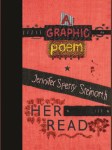
Jennifer Sperry Steinorth / Her Read
Fantastic multilayered artifact that take the “his” out of Art History. Incisive corrective cut-up and erasure poems, and collage. Would love to see the original pages in 3-dimensions. (2021)
“so
we are
made
made
in pain to pose
and shimmer”

Jon Fosse / Aliss at the Fire
My first foray into the work of Jon Fosse, the 2023 winner of the Nobel Prize for Literature. A house of mirrors conflation of memory, loss and grief—and the transcendent part of the art of being human. Hypnotic. Resonances of the film Last Year at Marienbad. (2003)
“the darkness is as heavy as he is himself, he thinks, and the darkness is dense and thick, now it is one single darkness, a play of blackness”

Sandra Newman / Julia
“The millions of readers who have been brought up with Orwell’s Nineteen Eighty-Four will find this a provocative and satisfying companion.”
— Bill Hamilton / Orwell Literary Estate Executor / The Guardian, 7 Dec 2021
No!
DoublePlusNo!!
Newman is a talented writer, no doubt. Why, if she couldn’t imagine her own original dystopic universe (which she can, read: The Men, … Ice Cream Star) — why did she have to meddle with this universe?
The pecuniary interests of the Estate? The desire to flog the cash cow again as the original creeps up on public domain? They were already talking series adaptations and film rights back in 2021/22 (see: The Guardian, Variety).
Hell, there’s a market there Mr. Hamilton—over 7,600,000 “shelvings” on Goodreads! Think of the filthy lucre!
No. Just crass as shit—as a literary ploy.
And Newman almost pulls it off, despite the plentiful eye-rolling moments throughout and the implausible “revolution ex machina” in Cps. 22 & 23—and the ludicrousness of the Crystal Palace scenes those truly sink the book for this Orwell (the author, not flawed human) fan.
I need a visit to O’Brien’s ECT table and a swing through Room 101 to erase some of this experience. Julia is so remarkably good in spots (that’s Newman’s talent & gift) — but remember most of the heavy lifting was done nearly 80 years ago. A familiar table is already set and waiting.
If one comes into this book tabula rasa, or didn’t enjoy being put through this ringer in high school or university, this reimagining may be for you.
I read 1984 for the sixth time, in preparation, before I sat down to Julia. I almost DNF’d this half a dozen times. But Newman often manages to give a new incisive facet to an image or line—or a droll observation on a well know scene. As well as some truly interesting angles on the proles and reformed outer party types. Newman knows how to world build, although this one was already well-known and constructed; she’s is a deft wordsmith.
But im also reminded of how crass commercial grabs from estate agents and family are, and how a talented writer can write god-awful fan fiction at times—because this is what Julia is—a better quality fan fiction; and the most cynical part of post-modernity (and I’m a great fan of postmodernist pastiche).
There are great moments in the SAZ, at Truth, and new facets to Love and the proles, but I found some of the scenes at Women’s 21 and especially the last two chapters (22 & 23) bordering on the worst of YA lit.
Unfortunately Orwell couldn’t write his own sequel, if he were to wish to write one—but his estate and some of his family had no qualms (let’s squeeze every last farthing out!) about giving the go ahead for this. And Newman was game…and sometimes lame.
At least Atwood was able to write The Testaments herself … but wait I hear wings beating and birds circling, biding their time, overhead … soon enough we’ll have The Handmaids Tale from the eyes of the chauffeur. Hold on, Margaret, hold on!
If you think 1984 is a classic, a masterpiece, written by a flawed, all too human, individual and don’t want to have an alternate universe unspool and potentially mar your future readings or memories of 1984 then read Newman’s The Men, et al, instead. Newman can definitely write well.
In my decades on earth I’ve only returned a handful of books…this is one of them.
(Like Johnny Rotten said on stage in Frisco, as the Sex Pistols detonated, in 1978: ever get the feeling you’ve been cheated? Good night! (2023)
“This part of the ritual was always a release.
Everyone relaxed and beamed. Another thought had been correctly thought, another feeling rightly felt. One saw how little the Party asked, after all. You needn’t know all the latest Newspeak words or struggle to believe contradictory things. If you hated the enemy, you could be loved. People smiled dopily at each other, and some eyes welled with tears.
They had had a good Hate.”
(P.S. 1/17/24: I just finished reading The Men. Very disappointing too. Wouldn’t recommend that either)
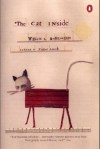
William S. Burroughs / The Cat Inside
Mostly sweet, mostly cat-related anecdotes, and some nightmares (this is Burroughs!) that read like microfictions in this slight collection. Minor Burroughs is good Burroughs, it is “Uncle Bill,” after all. But it’s hard to square this “softy” with the warped visionary who brought us Naked Lunch, Junky, The Ticket that Exploded, et al. (1986)
“We are the cats inside. We are the cats who cannot walk alone, and for us there is only one place.”
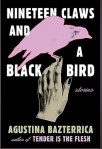
Agustina Bazterrica / Nineteen Claws and a Blackbird
“Dishwasher” and “A Light, Swift, & Monstrous Sound” are gems, reminiscent of Bazterrica’s fever dream debut, Tender Is the Flesh, and prove the collection worth reading.
The collection is front-loaded with the better stories. Gothic turns (a la Poe or Lovecraft, that ain’t my cup o’) and some mediocrities—especially in the latter half—and a couple of clunkers there. (2020)
“How can we be sure this ashtray isn’t really alive? I’m afraid of the shadows that things project. The shadows of things impact my face and leave small bruises.”
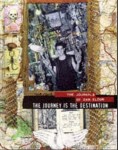
Dan Eldon / The Journey is the Destination: The Journals of Dan Eldon
Very engaging to look at, visually striking, anthology of Eldon’s journals from roughly ages 14 to 22. Eldon was killed working as a foreign correspondent in Somalia in 1993.
Traces the visual development of a bourgeoning artist / photojournalist—though the lack of contextualizing writing, save his mother’s posthumous introduction, renders this collection at times too impenetrably personal. (1997)
“Greetings to the person reading these words 50 years from now”

Sandra Newman / The Men
Disappointing. Many interesting philosophical and socio-political / cultural ideas engaged, too many maybe. The achilles here—as it was in Julia—is the denouement: a roll-your-eyes mouth agape stunner. Really? That was the catalyst for the disappearance of all the men? (no spoilers here)
Hell, no! It’s like a metaphorical juggler with too many items in the air (balls, a scarf, a chainsaw, etc.) with the inability to control all the elements.
Moments of excellent writing and world building, but again (as in Julia) treacly tendencies toward pat & happier endings, implausibilities (even for speculative fiction), puerile sex (no nuance but the bludgeon) a cataclysmic dystopia, moving toward utopia, ending as a (I won’t reveal the spoiler here) but it’s extremely unsatisfying.
Ugh. Ludicrous catalyst & closure. Ugh, again. No more Newman for me. Luckily it was a library borrow this time around. (2022)
“… she knew that whatever it was had removed every human with a Y chromosome, everyone who’d ever been potentially capable of producing sperm.”
Bertolt Brecht / The Life of Galileo
Reading theater is never quite the same as experiencing it viscerally: with sets, music, movement. Differences in the Laughton v. Hare translations / adaptations, but very worthwhile reading. Without German to help I can only imagine what the original is like—through reportedly Brecht worked with Laughton on the second (American) version. Still relevant and prescient today—maybe more so. (1938)
“GALILEO: Well. This age of ours turned out to be a whore, spattered with blood. Maybe, new ages look like blood-spattered whores. Take care of yourself.”

Maya Binyam / Hangman
Unfolds as the protagonist finds himself travelling back to the country he fled three decades earlier (ostensibly Ethiopia of Eritrea). Great debut novel.
Direct yet circular. Quotidian yet surreal in spots. A Kafkaesque odyssey — and the end that awaits us all. Darkly humorous. (2023)
“I would never be able to find out why my life had been the way it was. Everything was nothing, and that was how it was going to stay. I wanted to cry, but I could not cry. I had no eyes. I wanted to go home. I tried to go home home was inside of me.”
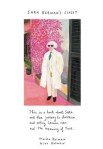
Maira Kalman / Sara Berman’s Closet
Excellent, short, illustrated biography. A 60 year old woman radically uproots her life in Israel and chooses to live her authentic life out in NYC. Nicely rendered freehand drawings, paintings and treated photographs. (2018)
“Everyone Leaves somewhere.
Everyone leaves everyone.
And there you go.”
Jon Fosse / A Shining
Fosse’s first post-Nobel publication in the States. I’m starting to discern Fosse’s circular simplicity…
And now I’ve read this book, and maybe I never read this book. Maybe I only imagined I read this book. Imagined that I saw the pages turning and scanning words. No, that’s totally unthinkable. I read this book. And I finished it not yesterday, but today. Yes, today. It was like the previous Fosse I read. I did read it all right. And I say: Yes, I read it. And it was either good or not. Yes. Anything is possible. Yes. (2023)
“And I’m alone in the darkness again, exactly like I was before.”

Nick Fuller Googins / The Great Transition
This lives in one of my favorite subgenre universes, but this book is far from a favorite.
Ludicrously melodramatic pulp, and set pieces, bordering on the worst YA has to offer. Riffing on Kim Stanley Robinson without the chops or the heft.
Some really dumb characterizations—were the editors asleep at the desk? Felt more like a waste of time the farther I ventured into the narrative. Shoulda DNF’d it—there was nothing fulfilling or illuminating upon reaching the last word (which didn’t come soon enough).
I didn’t know this was YA lit until I read a review after finishing the book—but that’s no excuse—I didn’t feel this way reading E.B. White or Cory Doctrow, et al., as an adult.
If you’re looking for a great “dystopic / climate apocalypse” pick up Debbie Urbanski’s After World instead. (2023)
“Everyone trying to flee, but only one planet. The world scattered and on the move. Unable to rest. Like me.”

Yana Vagner / To The Lake
World wide plague breaks out, and this one is centered in Moscow and its northwestern environs.
A gripping read. Had to read it as straight-through as possible—thee or four sittings. I have no idea how I missed this until now. Engrossing, addictive read, yet lacking the re-readability and philosophical import of The Road or The Plague. It’s a great human dynamic study of pandemic / post-apocalypse times.
(side note: not enjoying the testosterone-laden / action-hero / splatter fest tenor of the Netflix series adaptation, 2 epsisodes in (apparently catering to 16 year old boys?!) Other than the source material I understand Vagner had no hand in this potential mess)
Hoping for an English or Spanish translation of the sequel. (2011)
“Then everything happened at once, as if a curtain had been raised, and information poured over us like churning waters. We were horrified at how complacent we had been: four hundred thousand people were infected.”

Mosab Abu Toha / The Things You May Find Hidden in My Ear
Amazing collection of poems, detailing a life—and an arduous experience—of constant existential challenges / thretas.
How does one not only survive, but manage to occasionally find beauty, and continually strive for meaning, in this often hellish landscape.
Drones pervade so many of the poems—before reading Toha I had no conception of what that pervasive intrusion might be like; and those are the least of the threats (F-16s, tanks, missles, nail bombs).
Family, culture, and history prove to be the unguents, and of course the poetry Toha finds and makes amidst these existential challenges. Should be required reading everywhere. (2023)
“Raindrops slip into the frying pan
through a hole in a tin roof . . .
. . . It’s been noisy for a long time
and I’ve been looking for a recording
of silence to play on my old headphones.”
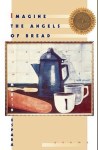
Martín Espada / Imagine the Angels of Bread
Espada, for me, is the poet laureate of the immigrant experience, the working class, and social protest. Being bicultural and first generation American-born myself—I see both my and my parents experience in this tremendously righteous and deeply felt work—and rendered so excellently. Fantástico. Working my way through his entire shelf. (1997)
“Here in the new white neighborhood,
the neighbors kept it pressed
inside dictionaries and Bibles
like a leaf, chewed it for digestion . . .
. . . I saw it
spraypainted on my locker and told no one . . .
. . . watched it spiral into the ear
of a disappointed girl who never sat beside me again. . .”

Haruki Murakami / The Strange Library
Slight, whimsical, Murakami, which is better than most. Not quite a graphic novel, and not quite a novel either, but an engaging short novella about a boy, an old man, a beautiful girl, and a sheep man wandering the bowels of a strange library. Perfectly illustrated. (2005)
“I knocked. It was just a normal, everyday knock, yet it sounded as if someone had whacked the gates of hell with a baseball bat.”
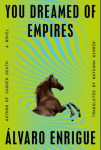
Álvaro Enrigue / You Dreamed of Empires
Absolute tour de force. A trip of a reimagining of the Cortés / Moctezuma conquest story. This man knows his way around a “world-build.”
A dreamlike succubus of a novel that thoroughly sucked me in (but you must allow it).
I loved the handful of expertly placed meta-moments throughout and the anachronisms—magisterially rendered. And that one particular trippy musical moment… (no spoilers here)… wow! WOW!
Just when I thought Enrigue had rushed it to smithereens in the penultimate chapter, he executes a fantastic turn and absolutely nails the come-uppance of a speculative moment in the last sequence.
I’m rushing to get Sudden Death and the rest of AE’s ouvré. Devoured it in 2 sittings. Fan-fook-in-tastic! (2024)
“In the end, the encounter was mostly disappointing, neither memorable nor fruitful. It left no one satisfied. The conquistadores were disappointed by the brevity of the ceremony and Moctezuma’s blatant lack of interest in hearing the message from Charles I, and the Mexica were confused that the huey tlatoani had finally decided to leave his chambers only to meet this pack of clowns. If there’s anything Spaniards and Mexicans have always agreed upon, it’s that nobody is less qualified to govern than the government itself.”
What I’m Reading:
“. . . in Mexico City around the time of the winter solstice, night doesn’t fall, it spills.”
— Álvaro Enrigue / You Dreamed of Empires

 thee istsfor manity reader